In the era of AI, redo ERP
 admin
admin
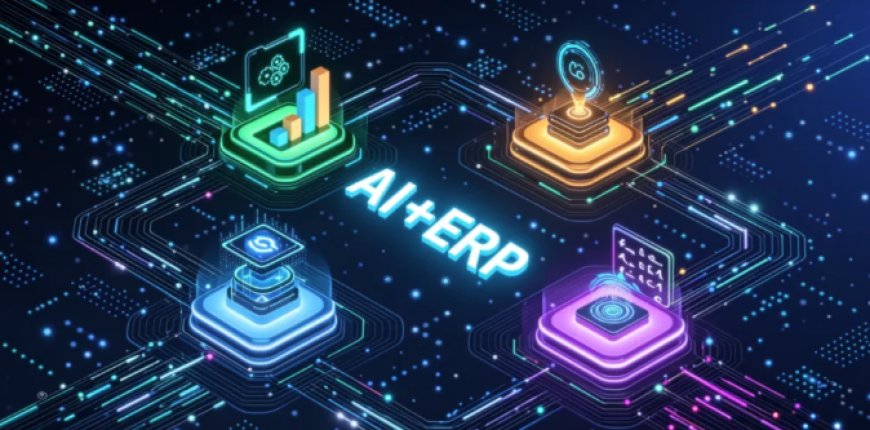
To what extent has the ERP industry been impacted by the wave of AI sweeping across?
If ERP does not make changes in line with the A era, the robust core originally built by ERP will be eroded by various agents. ”A senior ERP executive described the current situation in this way. And once this erosion is formed, it will have to cede more boundaries.
When AI agents begin to truly create value on the front line of business, ERP - the core digital system of enterprises - is standing at the forefront of change. ERP vendors have to face the question: Should they make up for it or start over from scratch? And as the generation gap between various AI technologies narrows, what are the future competitive advantages?
AI, It is reshaping the form, value, and future competitive landscape of ERP in an irreversible way.
How can AI reshape ERP?
Returning to ERP itself, its core concept is to integrate and optimize internal and external resources of enterprises through an integrated information management system, aiming to connect key business processes, dismantle "information silos", help enterprises reduce costs and increase efficiency, and support scientific decision-making. But this intricately designed theory often leads to new efficiency bottlenecks in practice.
Traditional ERP is built on top of relational databases and comes with highly integrated and standardized business data models and process logic. Enterprise users typically need to input structured master data and business data according to this framework. Although this approach ensures the consistency and accuracy of data throughout the entire system, making it easy to store, manage, and call in real-time across departments, it also leads to its inherent core pain points: weak ability to process unstructured data, as well as strong rigidity and insufficient agility.
Ultimately, the user's intuitive perception is often that the system is rigid and data entry is cumbersome. The more profound impact is that its demand forecasting module based on historical structured data is prone to failure in the rapidly changing market, making it difficult to provide effective support for decision-making.
To address these pain points, cloud native architecture and low code/no code platforms have become popular paths for ERP evolution. Cloud native enables ERP to move from "cumbersome" to "agile", while low code/no code gives it the "flexibility" to respond to business changes.
However, as the system becomes cloud based and processes become more flexible, the massive data value accumulated in ERP urgently needs to be tapped. At this point, the injection of AI technology has become a crucial leap, equipping ERP with an "intelligent brain". It is mainly reflected in:
AI intelligent predictive analysis: Integrating historical data and real-time information predictive analysis to achieve more accurate demand forecasting and inventory optimization.
Automated process optimization: Based on AI learning, automatically identify process bottlenecks and recommend optimal solutions.
Computer Vision and Natural Language Processing: Automatically process unstructured information such as receipts through OCR, reducing the burden of manual input; Conduct sentiment analysis and demand mining through NLP analysis of customer service recordings, social comments, and other text. Finally, these insights will be linked with ERP core data to drive business growth.
Currently, as the technological path of big language models is validated, their related capabilities are increasingly being delivered to users through natural language interaction as a visual approach. However, in the industry's view, AI's changes to ERP should not only be limited to the level of technology overlay and usability improvement, but also require in-depth restructuring of core business processes.
"We often say that so and so software, such as Internet software, industrial software and design software, actually the attribute 'what' software in front of the software is very important." Lai Yunchun, ERP product director of Endpoint Technology, said frankly.
The reason behind this is that ERP software is essentially a management software, but traditional ERP only solves what, who, and how (what to do, who to do, how to do it), and its most critical "decision-making" link has long remained at the manual level.
Therefore, in the context where "intelligence" has become the "standard configuration" of ERP systems, the change of AI+ERP should enable the implementation of classic management methods and truly translate them into business results.
AI Path Perspective: Native, Platform, Scene, Vertical
It is based on the consensus on "landing business results" and the judgment of the trend of the times that the transformation in the ERP field is imminent. Mainstream ERP vendors are also exploring differentiated AI evolution paths based on their respective advantages, and trying to "redo ERP".
Among them, AI Native is considered a popular trend in AI+ERP and is one of the most likely concepts to help enterprises achieve AI driven comprehensive transformation. Different from the mainstream approach of embedding AI into current product forms, AI native emphasizes "AI first ERP". In addition to bringing new ways of interaction, AI native products basically meet three significant characteristics: AI technology, as the core function of the product, runs through the entire architecture; Being able to manage the lifecycle of products through AI, data-driven self evolution, and continuous iteration; Can adapt more dynamically to changes in the scene.
The White Paper on AI Native Application Architecture released by Alibaba Cloud also explains this point: AI native applications emphasize that they are intelligent applications that are based on large models as cognitive foundations, agents as orchestration and execution units, data as decision-making and personalization foundations, and perceive and execute through tools. At present, the concept of AI native has been practiced in the ERP industry, such as the recently released "AI native ERP" by Endpoint Technology, which is based on a multi-agent architecture to build an "AI consultant matrix" covering the entire process of strategy, procurement, sales, finance, etc. Business processes can be driven by natural language. Through multi-agent collaboration, the overall workflow has shifted from a "human operating system" to a "system commander".
For example, if the user proposes the goal of launching new product A, the system will automatically break down the strategic goal and promote its execution, coordinating strategic decision-making, supply chain, market and other intelligent agents to complete the task. As a result, ERP has transformed from a passive "system" to an active collaborative "virtual organization".
Regarding the new trend of AI native technology, enterprises represented by endpoint technology are still actively exploring it. Due to the extremely high requirements for the data foundation and management maturity of enterprises in the implementation of AI native, and the significant cost of customer education, its feasibility in large and complex enterprises still needs long-term attention.
In addition to the trend path of AI native, mainstream ERP vendors at home and abroad are currently trying a gradual approach, that is, embedding AI capabilities based on existing architectures and product forms, and they are also presenting different focuses.
As global leaders in the ERP field, SAP and Oracle's choice is more like a platform empowering path - using AI as an enterprise level "enhancement layer". The core logic is not to overturn the existing ERP architecture, but to inject AI into the entire cloud platform in the form of public services, making it accessible to all business modules and achieving progressive intelligent upgrades.
SAP uses the SAP Business AI platform and embedded digital assistant Joule to enable users to obtain AI assisted analysis and decision-making through natural language interaction when processing specific business such as approving invoices. For example, production planners can use Joule to understand anomalies in the scheduling process and quickly locate problems. Oracle has built-in AI assistants in its Oracle Fusion Cloud ERP and provides data science and machine learning services on its underlying cloud infrastructure (OCI) to help enterprise customers build customized AI applications based on their own data.
However, some argue that this platform based path is like "changing engines for an airplane in flight", where SAP and Oracle's AI capabilities must adapt to their vast existing architecture and standard processes, which constrains the pace of innovation and makes its value highly dependent on customers' implementation capabilities, making it difficult to quickly deliver in all scenarios.
Unlike platform based paths, manufacturers represented by Kingdee and UFIDA focus on scenario embedding routes, with a greater emphasis on "out of the box" AI functions, targeting high-frequency pain points in specific business scenarios, and pursuing quick and perceptible investment returns for enterprises.